.png)

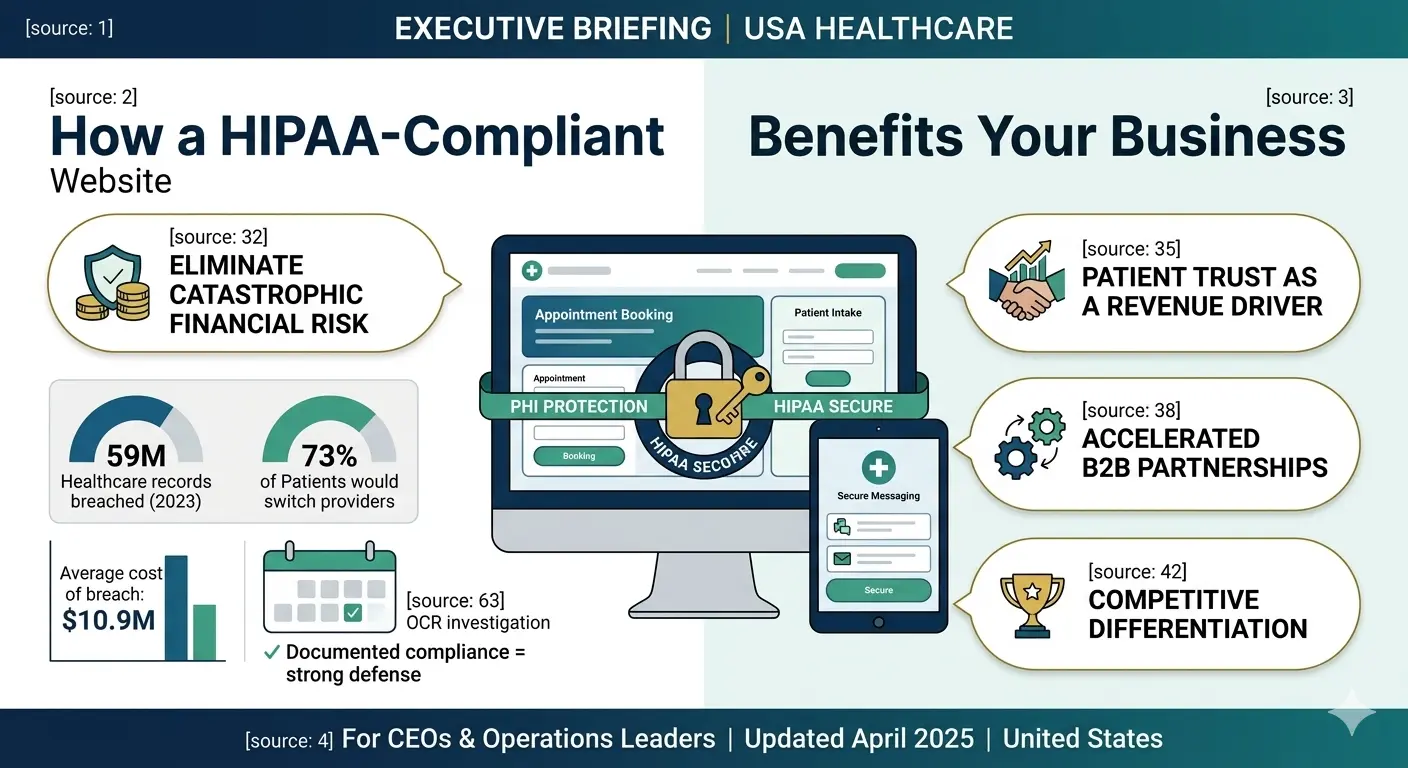
For CEOs & Operations Leaders | Updated April 2026 | United States
In the United States, healthcare organizations that collect, store, or transmit Protected Health Information (PHI) online are not just ethically obligated to protect patient data; they are legally required to do so under the Health Insurance Portability and Accountability Act (HIPAA). But here is what most executives miss: HIPAA compliance is not merely a legal checkbox. It is a powerful business asset that reduces financial exposure, unlocks new revenue streams, accelerates sales cycles, and builds the kind of patient trust that no marketing budget can buy.
1. Why HIPAA Website Compliance Is a Business Imperative
Your website is no longer a brochure. For most healthcare businesses (hospitals, clinics, telehealth platforms, health-tech startups, medical billing firms, and insurance providers) the website is the primary point of patient interaction. Appointment booking forms, patient intake portals, online payments, symptom checkers, and live chat tools all handle sensitive data that falls under HIPAA's jurisdiction.
The question is not whether your website handles PHI. The question is whether it handles PHI lawfully, securely, and in a way that builds confidence rather than eroding it. When you invest in a HIPAA compliant website development process, you are not paying to satisfy a regulator. You are building a digital foundation capable of supporting your organization's growth, partnerships, and patient acquisition strategy for years to come.
| Metric | Business Impact |
| $10M+ | Maximum annual civil penalty per violation category |
| 73% | Patients who would switch providers after a data breach |
| 59M | Healthcare records breached in the U.S. in 2023 |
| $10.9M | Average total cost of a healthcare data breach |
2. The Real Cost of Non-Compliance: Penalties & Breaches
The Office for Civil Rights (OCR) at the U.S. Department of Health and Human Services actively investigates HIPAA violations and has levied significant penalties against organizations of all sizes, from solo practices to major hospital networks. Many of these violations trace directly to insecure or non-compliant web infrastructure.
Civil Monetary Penalties
HIPAA violations are tiered by culpability. Fines range from $137 to $68,928 per violation, with annual caps reaching $2.07 million to $10.3 million per violation category. A standard non-compliant contact form capturing a patient's name, email, and health concern, replicated across thousands of visitor sessions, could constitute thousands of violations.
Executive Risk Alert: A standard, non-compliant contact form on your website that captures a patient's name, email, and health concern is already transmitting PHI insecurely. Penalties compound rapidly, and ignorance is not a valid legal defense under HIPAA.
Criminal Liability
Beyond civil penalties, intentional or willful violations can result in criminal prosecution. Executives have been personally charged and sentenced. As a CEO or COO, your organization's digital compliance posture is your professional liability.
Reputational Damage
Every OCR breach investigation is publicly posted on what the industry calls the "Wall of Shame" (the HHS breach portal). A single public listing can cost your organization in lost patients, lost partnerships, and years of reputational repair. In healthcare, trust is the product. When it breaks, recovery is long and expensive.
3. Seven Strategic Business Benefits of a HIPAA-Compliant Website
Once you move past the risk-avoidance framing, the genuine business value of investing in a compliant digital presence becomes clear.
Benefit 1: Elimination of Catastrophic Financial Risk – Enforcement actions can cost millions. A $30,000 to $80,000 investment in proper compliant web development is an insurance policy with a clear actuarial case behind it.
Benefit 2: Patient Trust as a Revenue Driver – A professionally built compliant website signals that your organization takes privacy seriously. Trust converts to appointments and referrals.
Benefit 3: Accelerated B2B and Payor Partnerships – Having a demonstrably HIPAA-compliant website removes procurement obstacles during vendor compliance reviews.
Benefit 4: Competitive Differentiation – The majority of small-to-mid-sized healthcare businesses are not fully compliant. Getting compliant allows you to step ahead of the market.
Benefit 5: Operational Efficiency Through Secure Digital Workflows – Replacing fax machines and paper forms with encrypted messaging and secure intake reduces administrative burdens.
Benefit 6: Scalability Without Regulatory Re-Engineering – Building for compliance from the start means your digital infrastructure can scale without a complete rebuild later.
Benefit 7: Immunity to Evolving Regulatory Enforcement – A properly built website is designed to stay compliant even as guidance around tracking pixels and marketing integrations evolves.
Operations Win: Healthcare organizations with HIPAA-compliant digital infrastructure report up to 40% fewer administrative escalations related to patient data inquiries and significantly reduced IT incident response time.
4. Turning Compliance Into a Competitive Advantage
| Business Scenario | Non-Compliant Website | HIPAA-Compliant Website |
| Enterprise hospital RFP | Disqualified at vendor review stage | Advances to contract negotiation |
| Insurance network onboarding | Requires remediation before approval | Streamlined credentialing process |
| Patient acquisition via Google | Tracking pixels may violate HIPAA | Compliant analytics preserves ad ROI |
| OCR breach investigation | Potentially millions in penalties | Documented compliance = strong defense |
| Patient portal feature launch | Requires rebuild from scratch | Built on compliant infrastructure |
| Series A / PE due diligence | Compliance gaps reduce valuation | Documentation supports higher multiple |
5. The Operations Perspective: What Changes Day-to-Day
- Automated audit logging: Every data access event is logged automatically.
- Role-based access controls: Staff see only the patient data relevant to their function.
- Encrypted patient communications: Secure web forms and chat tools replace insecure email threads.
- BAA frameworks: Architecture identifies and formalizes all third-party vendor relationships.
- Faster incident response: Compliant systems have the documentation needed to respond within the 60-day window.
6. Which U.S. Industries Need HIPAA-Compliant Websites Most
- Hospitals, clinics, and physician practices.
- Telehealth and digital health platforms.
- Medical billing and revenue cycle management companies.
- Health insurance and managed care organizations.
- Behavioral health and addiction treatment centers.
- Health technology SaaS companies and medical device makers.
7. How to Get Started: From Assessment to Launch
- HIPAA Compliance Audit: Examine data flows, third-party integrations, and hosting.
- Architecture and Design: Build to meet administrative, physical, and technical safeguards.
- Development and Integration: Ensure every touchpoint uses HIPAA-eligible vendors with BAAs.
- Policy Documentation: Create written policies for privacy, data retention, and breach notification.
- Ongoing Monitoring: Establish a compliance calendar for periodic risk assessments.
8. Conclusion: Compliance as Growth Strategy
The question is not whether to invest in compliance. The question is whether you invest now, on your own terms, or invest later under the pressure of an OCR investigation or a failed due diligence review.
Published by Remah Tech | remah.tech | HIPAA-Compliant Website & Audit Services for U.S. Healthcare
This article is for informational purposes. For legal advice specific to your organization, consult a qualified HIPAA attorney.